

A quick guide to child safety reforms heading into 2026.
This is a quick pre-read for our upcoming webinar, Back to Basics: Getting Foundations Right in an Age of Reform, on 23 April 2026. The webinar itself won’t rehash what’s here, it will tackle the harder question: now that you know what’s required, what do you actually do about it?
If you work in child-related services (education, early learning, disability, out-of-home care, sport, or faith-based organisations) the regulatory ground has shifted significantly beneath you over the past two years.
Reforms that once existed as recommendations, principles, or policy guidance have progressively become law, and with them have come real penalties, liability, and urgency.
This article is a plain-language overview of where things stand.
It’s designed to bring you up to speed so you can get the most out of the conversation on April 23.
Child Safe Standards: From Policy to Mandate
The National Principles for Child Safe Organisations were endorsed by all Australian governments back in 2019, drawing directly from the Royal Commission into Institutional Responses to Child Sexual Abuse. For years they sat as a best-practice framework: aspirational, widely referenced, but inconsistently implemented.
That’s changed. Most states and territories have now embedded child safe standards into legislation or regulation, making compliance mandatory rather than optional.
Victoria led with its Child Safe Standards (updated in 2022), and other jurisdictions have followed with their own versions. The core expectations of governance, culture, screening, training, complaints handling, participation of children, are broadly consistent, but the detail varies by state.
What this means in practice: organisations can no longer treat child safe standards as a policy document to file away. They are an operational obligation that requires planning, resourcing, governance, and accountability across the organisation. Not just a single child safety officer carrying the load.
Working With Children Checks: National Convergence, Local Complexity
Working With Children Checks (or their equivalent e.g Blue Cards in Queensland, WWVPs in Tasmania) have been a feature of the landscape for over a decade. But the national push toward greater consistency has accelerated.
Key developments include:
- expanded categories of child-related work that require checks
- tighter obligations around monitoring and notifications (not just the initial clearance)
- and moves toward greater portability across state borders.
There is growing convergence in the principles, but organisations operating across multiple states still face the reality that each jurisdiction has its own rules, its own registry, and its own processes.
The practical challenge: if you can’t tell your board today how many staff have a current, valid check … and what you’ve done about those that are expired or under notification… you have a visibility gap that carries real risk.
Reportable Conduct Schemes: Expanding Fast
Reportable conduct schemes require organisations to investigate and report certain conduct by employees (or volunteers) involving children. New South Wales has had a mature scheme for years. Victoria, Western Australia, and the ACT followed. Queensland’s scheme commences in July 2026. Only South Australia and the Northern Territory are yet to introduce equivalent legislation.
The important nuance: the threshold for what constitutes reportable conduct has been raised in some jurisdictions. This means conduct below a certain severity (outside of sexual offences) may not trigger a report to the regulator.
That doesn’t mean organisations are off the hook. It means your internal systems: your code of conduct, your complaints processes, your investigation capability, need to fill the gap. If the regulator won’t hear about it unless it’s sexual in nature, everything else rests on you.
So how do you want to manage your workforce’s conduct?
The sector wide reality is that investigation capability is thin. Until recently, there was very little depth of experience in conducting procedurally fair, child-focused investigations outside New South Wales. Many organisations are relying on internal staff (principals, directors, HR generalists) who may not have the training or independence required.
Child Safety Training: Legislated, But How?
Mandatory child safety training has been part of the standards framework since 2019, but the operational details have been slow to crystallise. Recent mandates, particularly in early learning, have brought training obligations into sharp focus. In some jurisdictions, thousands of workers need to complete accredited child safety training within tight timeframes.
The questions many organisations are grappling with: who delivers the training? Is it verified against a recognised standard? How do you track completion at scale when your LMS doesn’t integrate with any compliance register? And critically, is the training actually changing behaviour, or is it a tick-a-box exercise?
Training matters. But training without a strong culture of safety, without clear behavioural expectations, an explicit code of conduct, and systems that support reporting, is only part of the picture.
Penalties and Liability: It's Personal Now
Across most jurisdictions, penalties for non-compliance with child safety obligations have increased. Fines are larger. Regulatory powers are broader. And there is a growing (if still somewhat ambiguous) push toward personal accountability for board members and executives.
The message is clear: safeguarding is a governance issue, not just an operational one. Boards that don’t understand their obligations or that lack the reporting and oversight systems to know whether their organisation is actually compliant are really exposed.
What This Means For You
If you’re a CEO, board director, or safeguarding lead, here’s the picture: the reforms are not new in concept.
Many of these obligations have existed in some form for years. What’s new is that they’re now legislated, they carry penalties, and the expectation of maturity has increased. Organisations that haven’t been building their systems, governance, and culture over the past five years are now under pressure to catch up. And fast.
Our webinar on April 23 won’t repeat what’s in this article. Instead, we’ll tackle the practical, sometimes uncomfortable questions: what do boards actually need to ask? What does a code of conduct look like when it’s genuinely your strongest line of defence? How do you build investigation capability when the sector barely has it? And when it takes three to five years to do this properly, but penalties are live now, so where do you start?
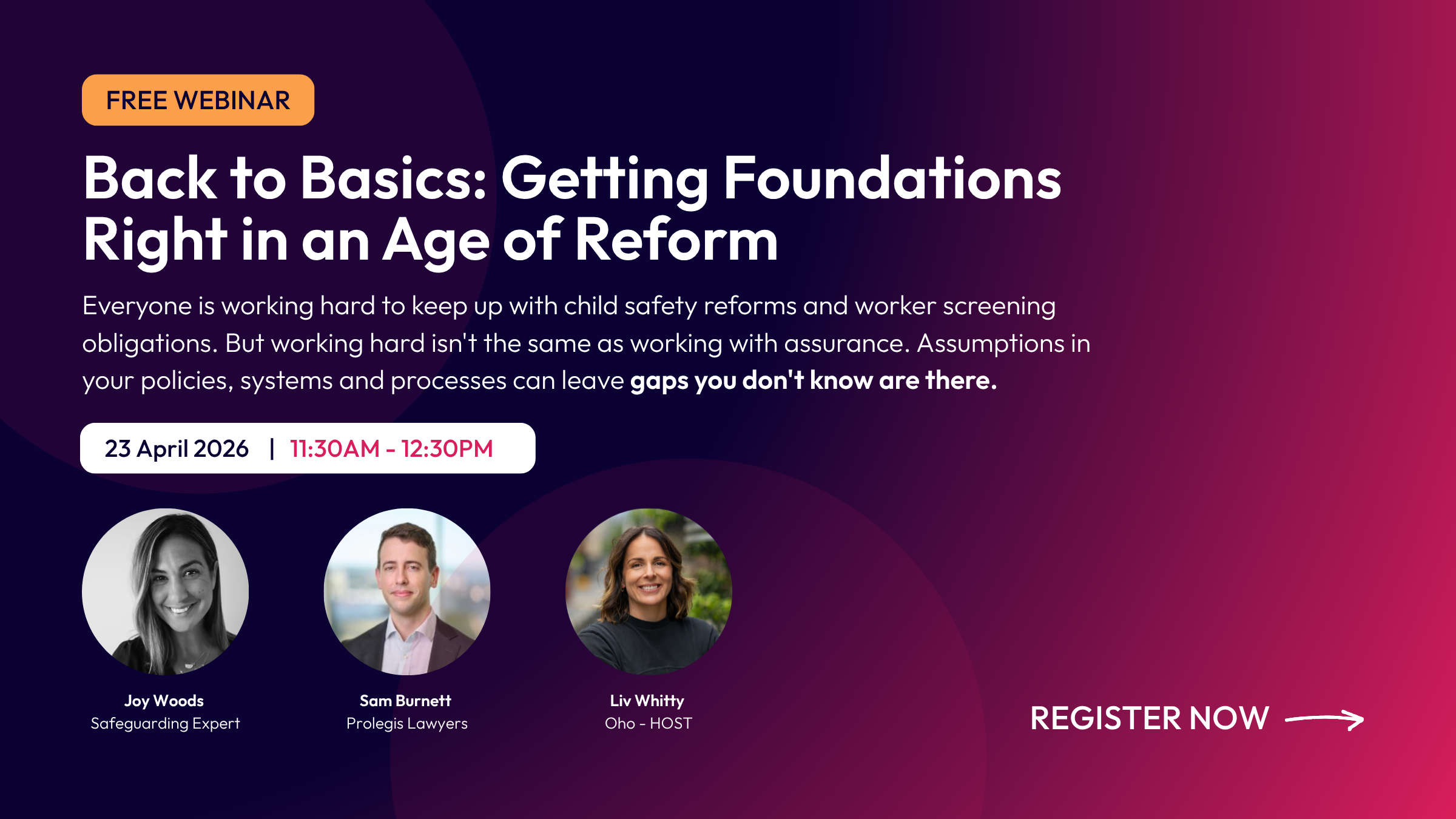
Free Webinar with Joy Woods (safeguarding expert), Sam Burnett (Partner, Prolegis Lawyers), and Liv Whitty (Oho CEO).
Register now ➞
This article is general information only and does not constitute legal advice. For guidance specific to your organisation, consult a qualified legal professional.